VIVIENCE HERITAGE · CULTURAL INTERPRETATION
Bringing history
back to life.
Intelligent digital humans and immersive heritage experiences designed to help people encounter, explore and question the past.
For museums, archives, archaeological collections, historical societies, municipalities and cultural institutions.

Illustrative concept visual, not a deployed installation.
THE PROPOSITION
Collections hold knowledge.
Visitors bring questions.
Vivience Heritage is a proposed, institutionally governed framework for interactive historical interpretation. It combines original digital-human production with curated knowledge, dialogue and immersive environments.
The objective is to offer a new way to explore an object, a place, a document or a historical question while keeping the boundaries between evidence, scholarly interpretation and reconstruction visible.
Vivience Heritage complements curatorial practice, archives and conventional visitor interpretation. It does not replace the authority of museums, archaeologists or communities.
VALUE FOR HERITAGE INSTITUTIONS
Interpretation with institutional purpose.
Vivience Heritage is commissioned around a particular collection and audience. The intended benefits are clearer visitor enquiry, accountable interpretation and practical stewardship of an institution’s digital experience.
01
Visitor enquiry
Invite meaningful questions about approved collections and their historical context.
02
Curatorial oversight
Define source boundaries, approved interpretations and revision procedures with curators.
03
Adaptable experience
Choose a site-appropriate installation, character and interface rather than a generic tour.
INSTITUTIONAL APPLICATIONS
One framework.
Different purposes.
The interpretative question should determine the technology, not the other way round.
01
Museums & galleries
Create conversational experiences associated with carefully selected objects and exhibitions.
02
Archaeology & historic places
Examine material culture, place, source context and competing historical reconstructions.
03
Archives & historical societies
Explore documents, photographs, oral records and local histories through guided enquiry.
04
Municipalities & cultural networks
Connect public heritage resources across venues, communities and local programmes.
THE VISITOR JOURNEY
From a collection to a conversation.
Visitors can begin with what interests them: an artefact, an image, a person, a place or a question. The system can encourage exploration, offer context and disclose uncertainty.
01
Encounter
Begin with an object, historic place or interpretative question.
02
Explore
Ask questions, inspect recorded sources and compare supported accounts.
03
Reflect
Understand what is documented, inferred, contested or remains unknown.
CULTURAL SETTINGS
Different histories. Their own voices.
An adaptable framework can serve diverse collections and traditions. The following images are illustrative possibilities, not commissioned installations or depictions approved by particular institutions.
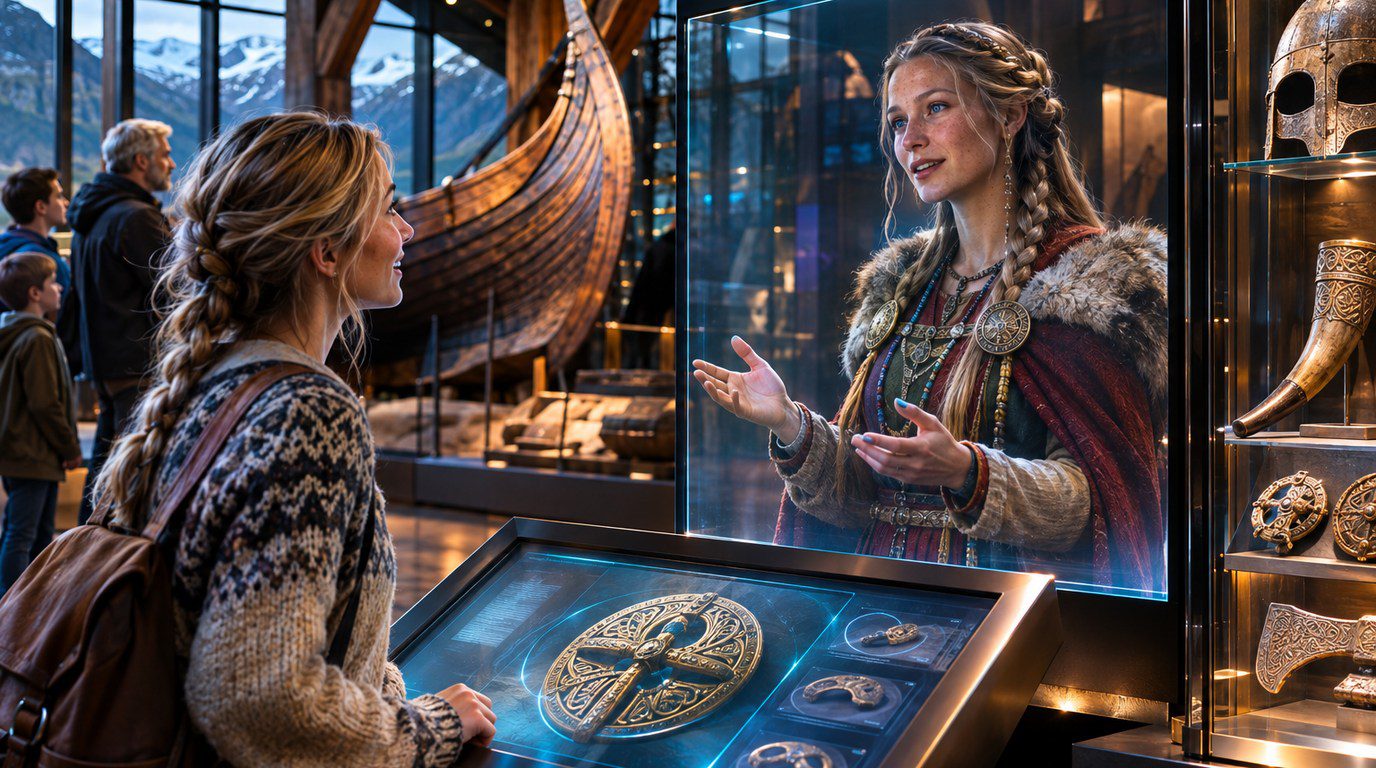
NORWAY
Viking Age & regional archaeology
Founding TRØNDFARA concept

SCOTLAND
Built heritage & historic landscapes
Explore different sources behind reconstructions

CROATIA
Mediterranean & Roman heritage
Connect artefacts with historic contexts

GREECE
Antiquity & material culture
Make source-led interpretation accessible
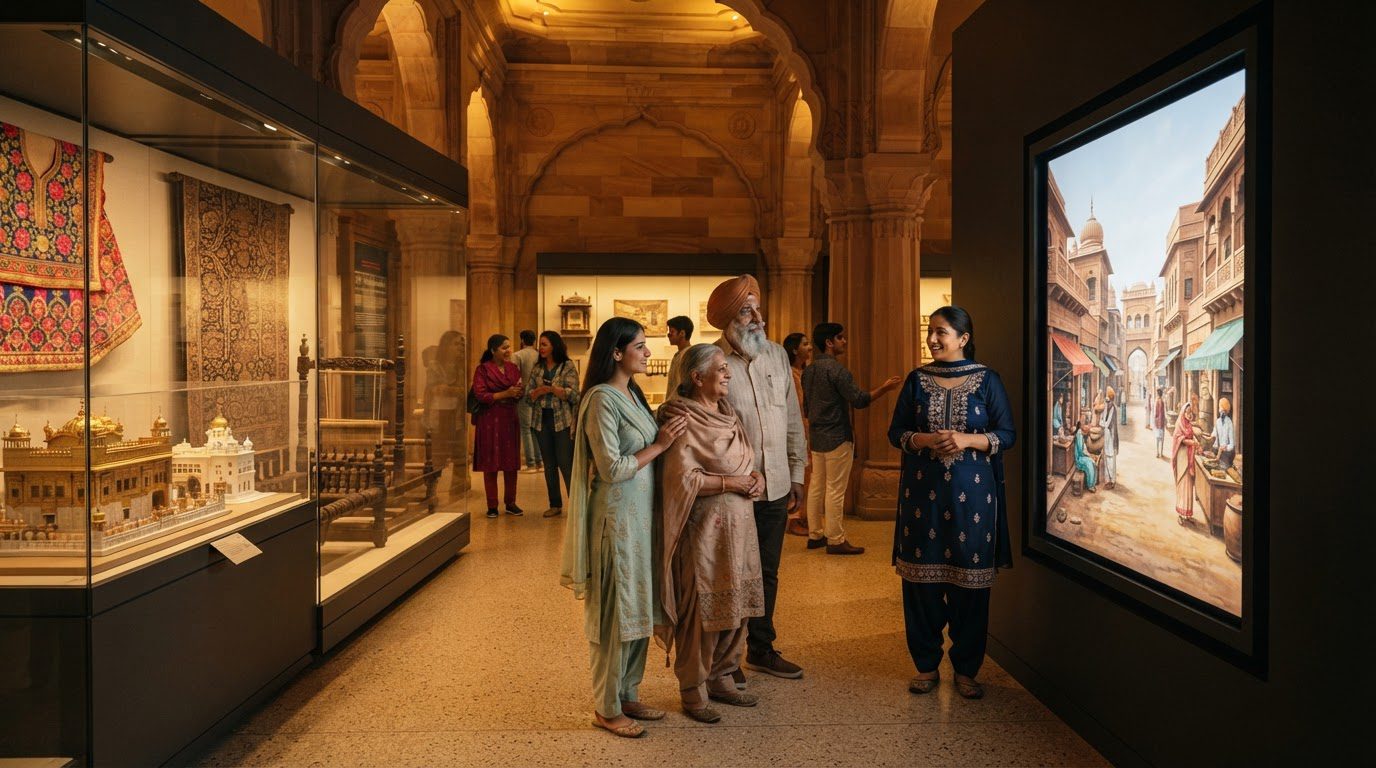
INDIA
Craft & community memory
Explore collections with local cultural custodians
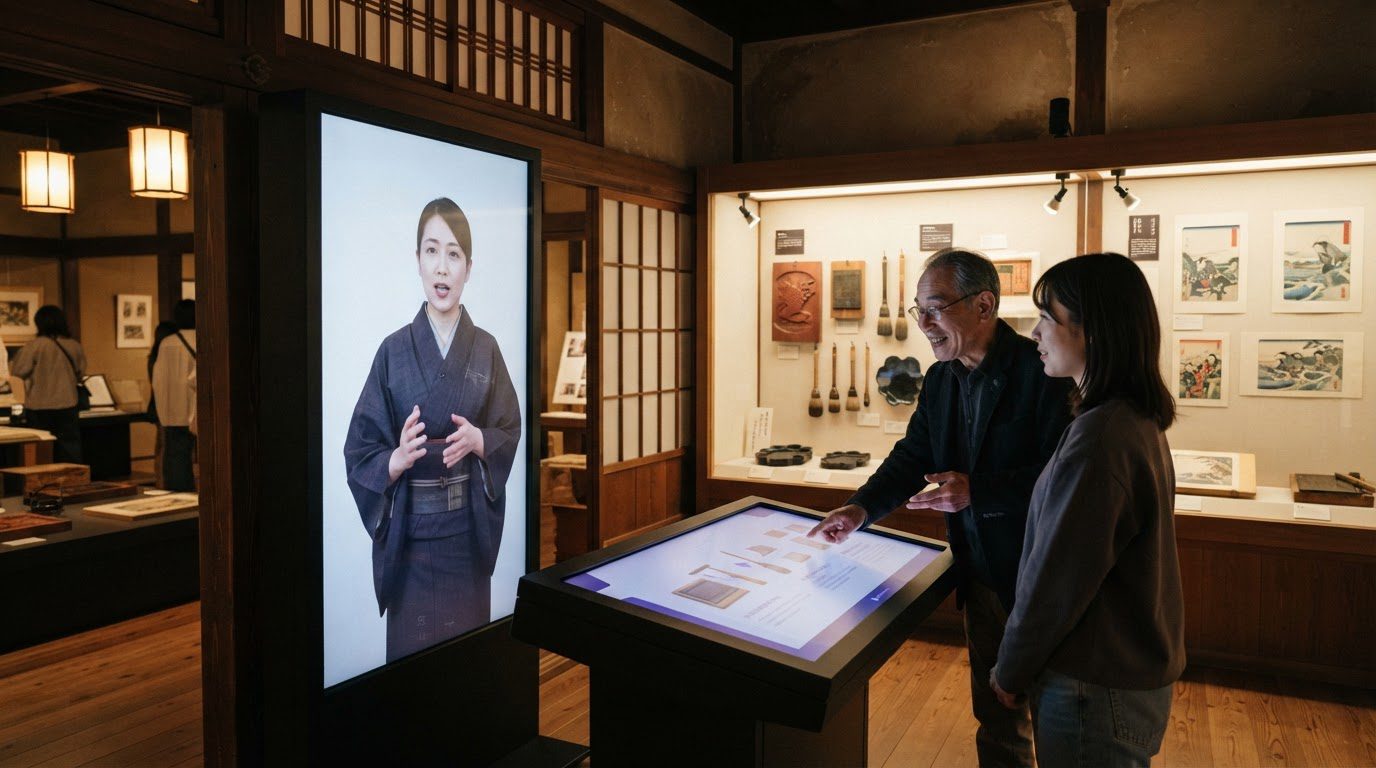
JAPAN
Craft & living traditions
Connect craftsmanship with meaningful public enquiry
HISTORICAL INTEGRITY
Evidence and imagination should never be confused.
Vivience Heritage proposes a traceable relationship between source material, scholarship, curatorial decisions, character dialogue and creative reconstruction. A convincing visualisation does not by itself establish historical truth.
Scholarly accountability
Substantive claims should be connected with identifiable sources and reviewable interpretation.
Transparent uncertainty
Visitors can distinguish documented, inferred, contested, reconstructed and unknown material.
Cultural stewardship
Permissions, community custodianship and institutional approval govern the experience.
FOUNDING NORWEGIAN CONCEPT
TRØNDFARA.
TRØNDFARA explores the possibility of bringing Viking-Age and regional archaeological knowledge into a visitor conversation through complementary interpretative personas.
A historically situated character may introduce contextual narratives, while an evidence interpreter examines source records, archaeological practice, scholarly disagreement and what remains unresolved.
TRØNDFARA is a Vivience research and development concept. The illustrated installation is not presented as an operating museum exhibition or as an endorsement by a heritage institution.
INSTITUTIONAL DELIVERY
Designed around your venue and visitors.
The programme can be tailored for selected collections, audiences and access needs. Delivery modes are scoped by the institution and the actual project requirements.
01
In the museum
A visitor-facing interpreter or interactive exhibit alongside collections.
02
Pop-up & touring exhibits
A venue-based installation for temporary exhibitions or touring programmes, scoped for the hardware, connectivity and operational conditions at each site.
03
Education
Question-led learning with source comparison and appropriate support.
04
Real-time environments
Immersive experiences when the historical purpose justifies their use.
VIVIENCE RESEARCH FOUNDATION
Research-informed character design.
LightArch and Annelore are existing embodied digital-human research personas. Their distinct conversational and character design provides a foundation for proposed Heritage-specific interpretation.
Published Affective-Emotive Resonance research informs the approach, but has not established visitor learning outcomes for museum installations.
Research Prototype · Reflective-Collaborative Persona
LightArch
A research digital human developed to investigate reflective collaboration, analytical empathy and relational continuity through a deliberately authored personality and knowledge architecture.
CUSTOM MORPHOLOGY · VOICE · PERSONA SCAFFOLDING · KNOWLEDGE · MEMORY · RELATIONAL DESIGN
Prototype 01
A distinctive reflective persona.
LightArch’s visual identity, voice, conversational behaviour and knowledge architecture were developed for reflective interaction and research.
Research Prototype · Relational-Empathic Persona
Annelore
A bespoke digital human developed to investigate emotional nuance, relational continuity and layered care while maintaining transparent AI identity and duty-of-care boundaries.
CUSTOM MORPHOLOGY · VOICE · PERSONA SCAFFOLDING · KNOWLEDGE · MEMORY · RELATIONAL DESIGN
Prototype 02
No two personalities are the same.
Annelore’s voice, temperament, backstory, knowledge, boundaries and relational behaviour were authored for her specific research purpose.
HOW WE WORK TOGETHER
Your collection. Your authority.
An institutional heritage experience begins with the material and the questions that the organisation wants audiences to explore.
Commissioning may involve archival assessment, cultural permissions, character design, interpretative production, accessibility, deployment, visitor evaluation and long-term support, according to the agreed scope.

Illustrative concept of an institution-led heritage interpretation workshop.
START A HERITAGE CONVERSATION
What could your collection say to its next visitor?
Speak with Vivience about a museum installation, archive, historical society, cultural programme or research collaboration.
Vivience Heritage
Trondheim, Norway
Vivience Heritage experiences are individually commissioned. Historical content, venue requirements, delivery method and operational responsibilities are agreed during discovery.